Blog

The DKS Journal latest issue is out and it carries 4 interesting articles on the status of Education and its background today. While Jitender Bajaj writes on the pre-Colonial education system that prevailed and highlights its purpose, curriculum, and pedagogy, Annamalai writes on the brief revival of the education system (what Gandhi termed the Beautiful Tree on which later Dharampal anchored his research, that forms the basis of Bajaj's article) by Gandhi under the aegis of Nai Taleem. An effort that was widespread with over 50,000 schools across India before they were defeated by the…

My close encounter with bureaucracy began in late 2009, when I was invited onto the Rural Development working committee of the Tamil Nadu State Planning Commission. It paused on 1st November last year. A few weeks before that, partner remarked that I had started to sound too much like the Government and needed a detox from “the System”. A Government retreat in the last week of October settled it: where I watched the key issues discussed in huddle and mediocre ideas occupied mainstage. I called my exit a “sabbatical” for couple of months and kept extending it, a couple of months at a…
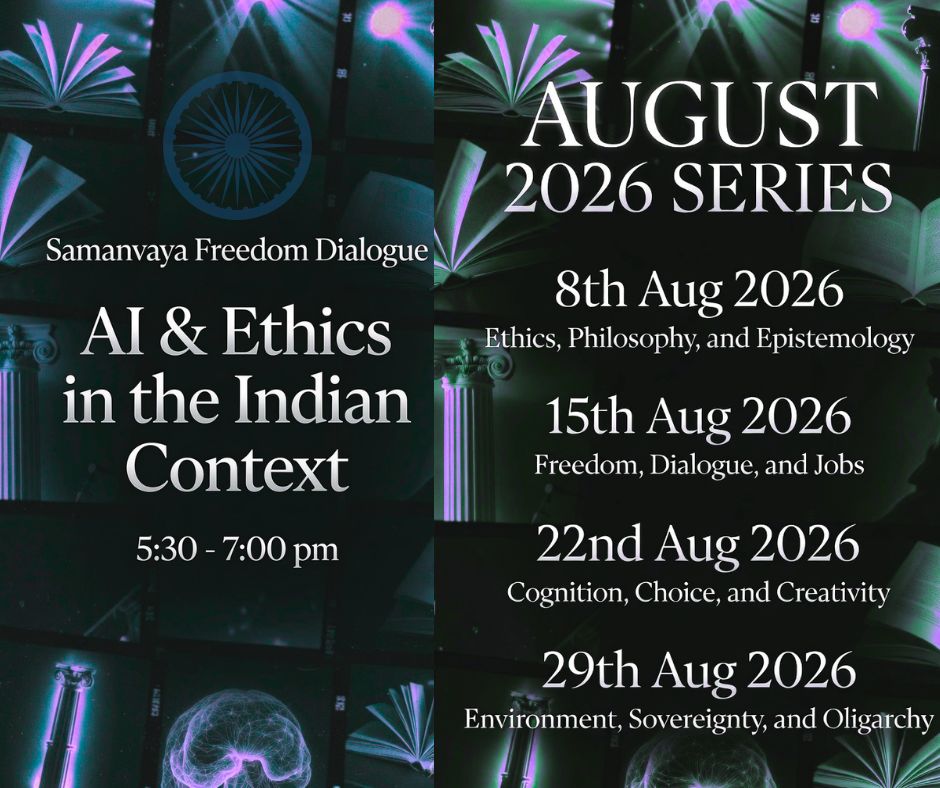
Read more about the Samanvaya Freedom Dialogue here on AI & Ethics in the Indian Context. The registration for this event that has already got an incredible lot of people committed to joining is here.
This is often not said these days – teaching status quo particularly in economy, management and entrepreneurship is easy compared to teaching that which is challenging the status quo.Status quo is reiterated by the day-to-day engagements of the learner - the way they commercially transact for day-to-day needs, the way they seek out services, even the visuals of the market communication that is all around. Daily news of policy that facilitates status quo economy, the advertisements of what is termed as ‘success’ in the existing market space, their products and services promotions, etc., also…

India's new rural employment framework promises scientific planning. It may instead be quietly rewriting the relationship between democracy, technology and the Indian village.The political debate surrounding the replacement of MGNREGA has been remarkably limited with much of the real issues being flagged by the civil society. The Government celebrates a larger vision of Viksit Bharat, longer employment guarantees and technology-driven planning. The Opposition has largely focused on the disappearance of Mahatma Gandhi's name. Both debates miss the more profound transformation now underway. The…

The Indian Grammar of InnovationHow adaptation, substitution, and self-reliance created a civilizational culture of innovationInnovation did not arrive in India through incubators, venture capital, or start-up ecosystems. It has always existed in our villages, workshops, farms, and homes.What made it possible was a civilizational way of thinking.Indian knowledge traditions are rooted in the idea of reducing suffering, living in harmony with one's surroundings, and making the best possible use of what is available. From this emerged three powerful principles that quietly governed everyday life…