India's new rural employment framework promises scientific planning. It may instead be quietly rewriting the relationship between democracy, technology and the Indian village.
The political debate surrounding the replacement of MGNREGA has been remarkably limited with much of the real issues being flagged by the civil society. The Government celebrates a larger vision of Viksit Bharat, longer employment guarantees and technology-driven planning. The Opposition has largely focused on the disappearance of Mahatma Gandhi's name. Both debates miss the more profound transformation now underway. The real story is neither nomenclature nor the number of employment days.
It is that India's largest rural employment programme is evolving from a rights-based guarantee shaped by local democratic institutions into a digitally orchestrated development architecture whose priorities are increasingly mediated by algorithms, data platforms and centrally designed planning systems.
That deserves far greater scrutiny than it has received. For two decades, MGNREGA represented an unusual constitutional experiment. Parliament recognised that rural employment during periods of distress was not welfare in the traditional sense but an enforceable legal entitlement. Equally significant was its institutional design. Employment was not merely delivered by the State; the works themselves emerged from the Gram Sabha. Villagers collectively determined what assets mattered most to their own landscape, livelihoods and ecology. That is how India created MGNREGA as the largest social security programme in the world.
The Draft Framework for the Viksit Gram Panchayat Plan proposes something considerably more ambitious. Planning is now expected to be supported through the Yuktdhara Planning Portal, geospatial intelligence, PM Gati Shakti infrastructure layers, India WRIS hydrological databases, satellite imagery, geo-tagged assets and outcome-based monitoring, all of which ultimately feed into a national Viksit Bharat National Rural Infrastructure Stack.
None of these technologies is objectionable. Indeed, they are impressive public digital infrastructure. The constitutional question is not whether technology should assist village planning. It should. The question is something far subtler. When does assistance become authority?
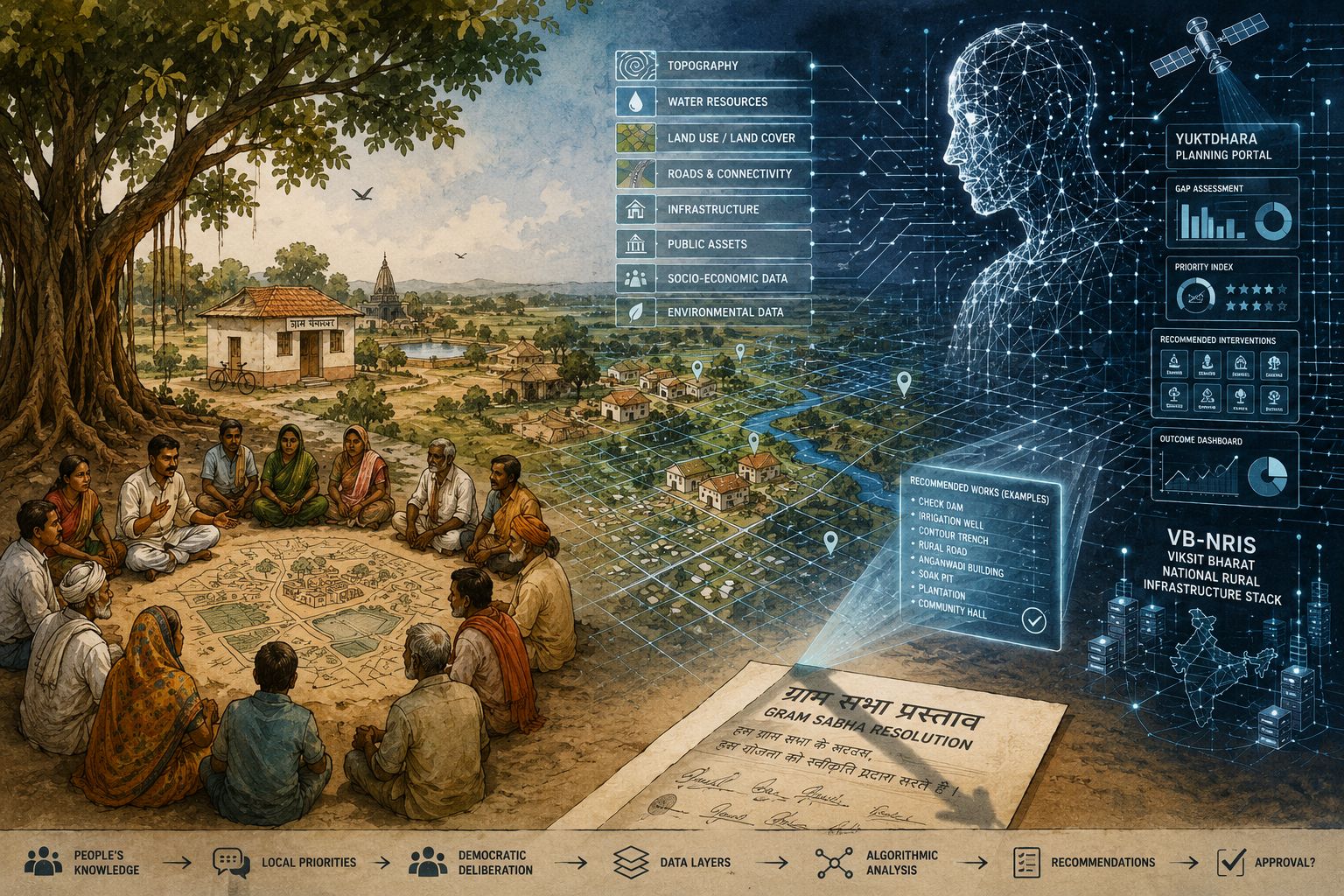
The Draft Framework repeatedly describes "scientific planning", "gap assessment", "outcome-based planning", "evidence-based decision-making" and "efficient allocation of resources" as the basis for identifying village priorities. Hundreds of predefined categories of permissible works are mapped against geospatial datasets, infrastructure inventories and measurable development indicators before planning begins. This appears administratively sensible. It is also where the character of democratic planning quietly changes. Traditionally, the Gram Sabha began with a simple question:
What do the people of this village believe requires attention?
The new planning architecture begins elsewhere.
What does the data indicate is missing?
That difference is not merely procedural. It determines who exercises the first act of judgement.
The algorithm becomes the first planner. The Gram Sabha becomes the reviewer. Democracy does not disappear. It becomes structured by software or its designers. The framework still requires Gram Sabha approval. Yet the sequence of decision-making has fundamentally changed. Recommendations emerge from geospatial analysis, infrastructure mapping, predefined activity catalogues and measurable outcome frameworks before villagers assemble to deliberate. The community is no longer presented with an open canvas. It is presented with a scientifically organised menu. This is the politics of pre-selection.
Power does not always reside in the final vote. Often it lies in determining which choices appear reasonable before voting even begins.
Every planner understands this. Every software designer understands this. Increasingly, public policy does too. There is another, less visible consequence. The architecture introduces an entirely new ecosystem of stakeholders into rural governance. The original employment guarantee involved workers, Gram Sabhas, Panchayats and programme officers.
The proposed framework adds geospatial platforms, digital planning portals, satellite databases, outcome dashboards, infrastructure registries, technical standards, AI-assisted analytics, district data validation systems and national planning repositories.
Technology is frequently presented as removing intermediaries. In reality, it often replaces human intermediaries with digital ones. The intermediary has not disappeared. It has simply become an algorithm with invisible designers, and managers. The irony is striking.
For decades, development economists criticised contractor-driven rural development because decisions gradually migrated away from communities. Today, decisions risk migrating instead towards data architectures. The village may still approve the plan. But the vocabulary through which priorities are expressed increasingly originates elsewhere.
Yet every algorithm reflects assumptions. Every dataset contains blind spots. Every optimisation function prioritises certain values over others. Technology does not eliminate politics. It encodes it. The village is perhaps the last place where this distinction matters most.
A satellite can identify a degraded watershed. It cannot identify why one hamlet distrusts another. A dashboard can optimise irrigation efficiency. It cannot understand why villagers choose to restore a sacred grove before constructing another check dam. A geospatial model can calculate runoff. It cannot recognise memory, culture, customary rights or local notions of justice.
These are not failures of technology. They are reminders of what democracy contributes that algorithms cannot. Communities negotiate values while algorithms optimise variables. The two perform entirely different functions.
The Draft Framework also places increasing emphasis on measurable outcomes, convergence with national priorities and evidence-based performance. Again, none of this is inherently undesirable. Public money should produce durable assets. Government programmes should be evaluated. Resources should be allocated intelligently.
But employment guarantees were never conceived primarily as productivity programmes. They were designed as social contracts during periods of rural distress. The constitutional legitimacy of MGNREGA lay not only in providing wages but in recognising that villages possessed the democratic competence to determine their own priorities. That assumption now appears to be changing. The future village envisioned by the Draft Framework is undoubtedly more connected, more measurable and more digitally integrated.
Whether it will also be more autonomous is another question altogether. Technology should illuminate democratic judgement, not quietly substitute for it. The real constitutional test of India's digital governance revolution is therefore not whether artificial intelligence can plan villages more efficiently than villagers themselves. It is whether the Indian State still believes that democracy begins with citizens—or whether it now begins with datasets.
The world today debates on Techno-Feudalism, our Parliament ought to start debating on the algorithmic governance and planning that is being promoted and whether this is the new pathway of Indian Democracy.
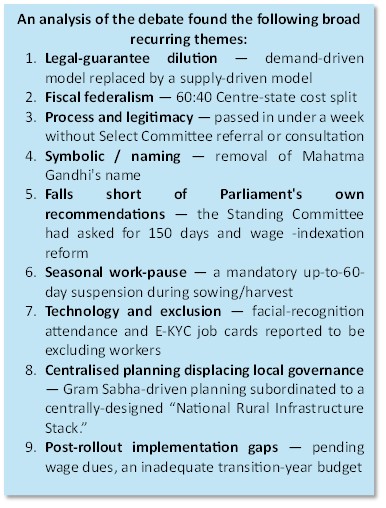
Disclaimer: I am aware that the guidelines come with the prefix “Draft” to it thereby denoting perhaps that the same may be revised later-on. My note here is more offered on the underlying Democratic pathways being chosen at this point in time and the perils thereof. I have left out other criticism of the VB gRAMg that have already been recorded by others (in the table above) as I had covered much of it in my own prior write-up on the same.
Add new comment