The DKS Journal latest issue is out and it carries 4 interesting articles on the status of Education and its background today. While Jitender Bajaj writes on the pre-Colonial education system that prevailed and highlights its purpose, curriculum, and pedagogy, Annamalai writes on the brief revival of the education system (what Gandhi termed the Beautiful Tree on which later Dharampal anchored his research, that forms the basis of Bajaj's article) by Gandhi under the aegis of Nai Taleem. An effort that was widespread with over 50,000 schools across India before they were defeated by the modernist project of the Navodaya schools. Prof CNKrishnan, writes on the aspect of building competent skills to be industry oriented, particularly in higher technical education institutions, and Prof Rajeev Sangal shares the application of an value education in one such technical education institution, rooted in the path of Madyastha Darshan.
The four articles (DKS Journal Issue 7, PPST)
- Journal index
- Krishnan, Formal System of Education in India
- Saboo and Sangal, Current Crisis in Education
- Bajaj, Education in India before the British
- Annamalai, Mahatma Gandhi's Vision of National Education
Reflecting on each of these articles
Prof. Krishnan's diagnosis is borne out by the recent data.
- The State of Working India 2026 report finds about 11 million of 63 million graduates aged 20–29 unemployed in 2023.
- Between 2004–05 and 2023, the economy absorbed only about 2.8 million of the roughly 5 million graduates added each year.
- Only 4.2% of workers aged 15–59 report formal vocational training (PLFS 2025).
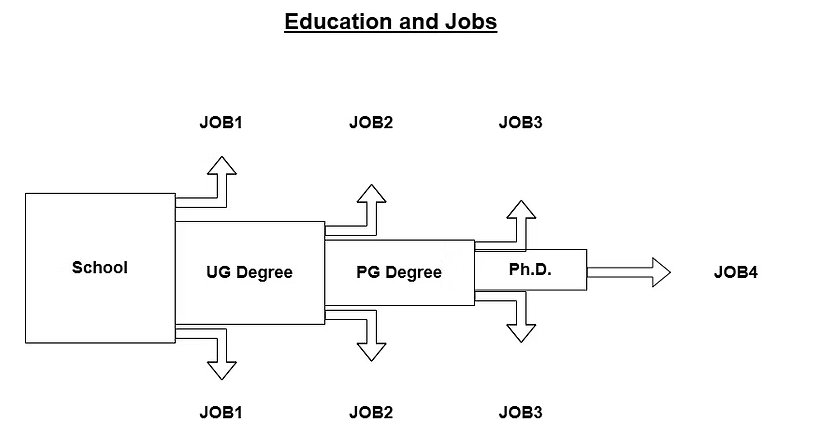
An education that treats each stage as a stepping stone to the next is, on this evidence, out of line with where most students actually go.
The Indian knowledge tradition offers a precedent for his alternative. The Madras Presidency returns of 1822–25 and Adam's Bengal reports, compiled in Dharampal's The Beautiful Tree, record schools teaching agricultural or commercial accounts according to the pupil's family occupation. Knowledge was organised around lokavidyā, the working knowledge of cultivators, artisans and traders, and passed on through apprenticeship within occupational communities and guilds (śreṇī). NEP 2020 itself names Lok Vidya as a source for vocational education. Krishnan's "terminal and local" stage is, in effect, a call to restore that alignment within a modern system.
The same data supports two cautions.
- First, India's most local, vocational institutions currently perform worst. The India Skills Report 2026 puts ITI graduates at 45.95% employability and polytechnic graduates at 32.92%, against 78–80% for computer-science and IT engineers, who are trained largely in universal content. SWI 2026 adds that the expansion of ITIs since the 2000s has come at the cost of institutional quality. Localisation without a quality mechanism risks reproducing these outcomes. The traditional model had its own quality control in the master craftsperson's judgement and the community's use of the product. Modern vocational streams have not replicated it.
- Second, the Tamil Nadu evidence on entrance examinations is incomplete. The State's own figures show rural admissions to engineering rising after 2006, but no independent study of graduate outcomes has been published. Abolishing entrance tests should be judged on outcomes, not only on access.
When reading the article by Dr. Saboo and Prof Rajeev Sangal, one tends to agree with the issue of student distress as a measurable crisis. NCRB records 13,892 student suicides in 2023, up from 8,423 in 2013. That is a 65% rise, against 27% for all suicides, and students now account for 8.1% of the total. The Supreme Court's National Task Force reports that suicide is the leading cause of death for women aged 15–29 and the second for men. It also found that 65% of the institutes it surveyed have no access to a mental health provider.
Their remedy draws on a sound Indian lineage. Madhyasth-Darshan, the basis of Universal Human Values (UHV), belongs with older Indian approaches that treat self-knowledge (ātma-jñāna) as a subject of inquiry rather than instruction. In those approaches the teacher accompanies rather than lectures, as in the Upanishadic dialogue and the guru–śiṣya relationship. The Taittirīya Upaniṣad's parting counsel to graduating students, satyaṃ vada, dharmaṃ cara ("speak the truth, practise dharma"), treats conduct as the purpose of education, not an elective. UHV's small mentoring groups, and its insistence that values be tested against one's own experience, are faithful to that tradition.
The international evidence is broadly encouraging. A meta-analysis of 424 studies covering 575,361 students (Cipriano et al., 2023) finds that universal social-emotional programmes improve relationships, behaviour and school climate. A 2025 meta-analysis finds an academic gain of about 0.10 standard deviations, roughly doubling for programmes longer than four months. That favours UHV's sustained, institution-wide design.
Three gaps, however, weaken the argument as presented:
- No published evaluation. There is no published randomised or comparison-group evaluation of UHV. The IRMA impact study is cited without figures, and could not be found it publicly.
- Structural causes. The Task Force traces student suicides chiefly to structural causes - both institutional and societal: caste, gender and language discrimination, ragging, academic overload, scholarship delays and vacant faculty posts. Value education cannot substitute for remedying these.
- Mentors are not counsellors. The Task Force warns against labelling untrained faculty as "counsellors". UHV mentors should be clearly distinguished from clinical support and linked to it through referral protocols.
The latest national data confirms Dr. Jitendra Bajaj's diagnosis of present-day schooling.
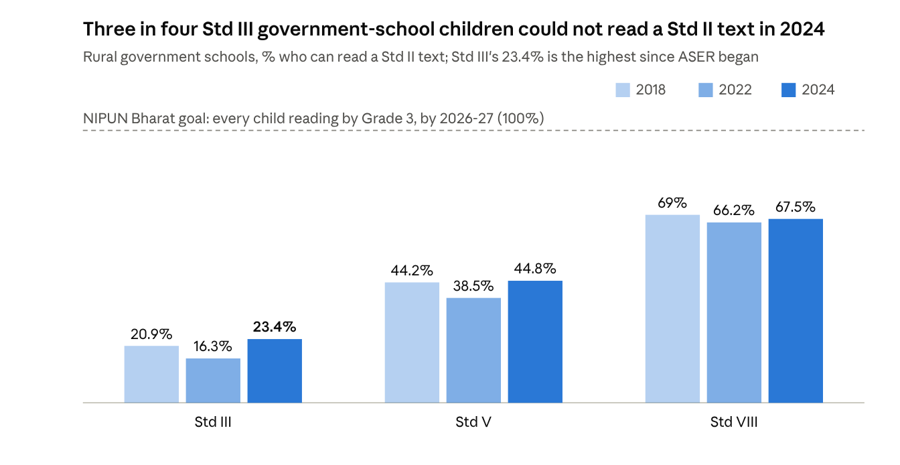
- ASER 2024 finds that only 23.4% of Std III children in rural government schools can read a Std II text, and 44.8% in Std V.
- Only 33.7% of all Std III children can do subtraction. PARAKH Rashtriya Sarvekshan 2024 reports that just 53% of Class 6 students know their multiplication tables up to 10.
- The NIPUN Bharat target of universal reading and arithmetic by Grade 3 by 2026–27 will not be met.
The indigenous record he draws on, the 1822–25 Madras Presidency survey and Adam's reports as compiled by Dharampal, is a genuine resource for Indian Knowledge Systems. It documents a low-cost system with three features:
- advanced pupils teaching beginners;
- economical methods of teaching writing, praised by the Collector of Bellary;
- accounts taught according to the family's trade.
Strikingly, the pupils came largely from what is considered the Lower Caste (Shudra) and other non-Brahmin castes.
The historical argument would, however, be stronger if stated more precisely:
- The 100,000 schools. Adam did not count them. He quoted an estimate made by a member of the General Committee of Public Instruction, extrapolated from 150,748 villages, and his own field surveys covered five districts.
- Coverage. The Madras returns Dr. Bajaj cites record 21.5% of boys of school age in school. That is wide reach, but not universality, and girls were almost absent from both surveys, though Dharampal records that the girls would have been educated at home.
- Literacy. Hartog's 1939 rebuttal used census data showing male literacy rising from 8% in 1881 to 14.4% in 1921.
Dr. Bajaj's case depends on efficiency and relevance, and on those points the primary sources support him. On the remedy, the evidence partly anticipates him. The largest gain in Std III reading in ASER's history, 7.1 points in government schools between 2022 and 2024, came after NIPUN Bharat made foundational learning the top priority. Concentrating effort on early reading and arithmetic works, though here within the NEP curriculum rather than in place of it.
Dr. Annamalai's account is a valuable reminder that India produced a coherent indigenous pedagogy in the twentieth century, not only in the eighteenth. Current evidence supports each of Nai Talim's three commitments: learning through productive work, teaching in the mother tongue, and character formed through practice.
- Language. UNESCO's 2025 guidance finds that 40% of people worldwide lack education in a language they understand, rising to 90% in some low- and middle-income countries.
- Practice-based learning. The 2025 meta-analysis by Ha and colleagues finds that programmes built into school life for longer than four months roughly double the academic gains of short ones.
- Need. Only 4.2% of Indian workers have formal vocational training (PLFS 2025).
NEP 2020's Lok Vidya, and its vocational exposure from Grade 6, are in effect an official return to Wardha.
The article would be stronger if it addressed why the experiment did not survive. By 1956 there were 47,813 Basic Schools with 5.06 million pupils, a modest network that state boards later absorbed. The Kothari Commission (1964–66) recast craft as "work experience", one element among many rather than the centre of the curriculum. Two current forces push the same way:
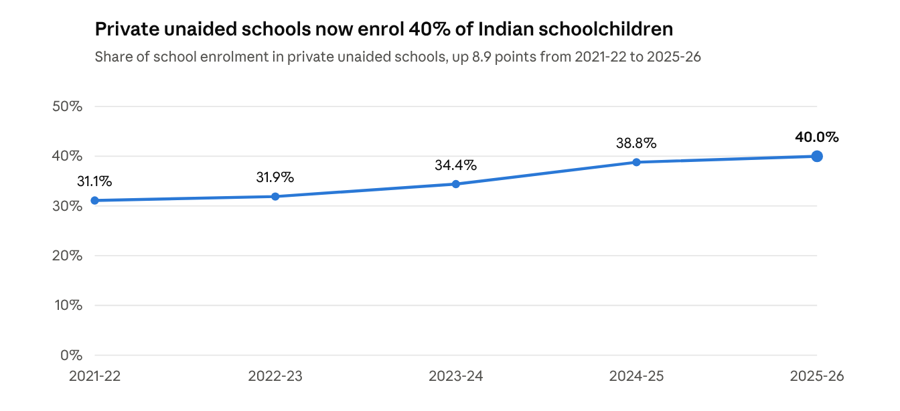
- Private schools. Private unaided schools now enroll 40.0% of schoolchildren (UDISE+ 2025–26), up from 31.1% in 2021–22. Parents' preference for English-medium teaching is commonly cited as a driver.
- The English premium. The labour market rewards English. In national survey data, fluent English raised men's hourly wages by about 34% (Azam, Chin and Prakash, 2013).
Gandhi's own position offers a resolution. He valued the mother tongue as the foundation but welcomed other languages as additional tools. The 1937 scheme also made craft the medium of learning, not a substitute for it. A contemporary Nai Talim could therefore be bilingual by design, with the mother tongue first and English added systematically. It could also use craft, agriculture and local technology as the context for mathematics and science in all schools, private as well as government.
While the 4 articles are all written with an interest and concern about the current schooling system, the challenges each one prioritizes and the pathways differ as well as the perspectives.
Question | Prof. Krishnan | Dr Saboo & Prof. Rajeev Sangal | Dr Jitendra Bajaj | Dr. Annamalai |
What is school mainly for? | Productive work in the local economy | Self-understanding, relationships, responsibility | Reading, arithmetic and practical accounts | Head, heart and hand together; character first |
Should values be taught? | Deferred to the companion articles | Yes, explicitly, in structured mentoring groups | No, not as a separate subject; the old system carried values inside language teaching | Yes, through work, school life and the teacher's example, not through textbooks |
What should the early years teach? | Vocational content for everyone, tied to the district economy | UHV, possibly from school level | Only literacy and numeracy for 4–5 years | Craft activity first; formal reading and writing come after it |
How do skills relate to academic study? | Each stage complete in itself and job-ready | Skills are needed but not enough | Practical accounts suited to the family’s / community trade | Craft is the way into academic subjects, not a replacement for them |
Who should run education? | The states, with the Centre setting only a framework | The head of each institution | Implicitly local, as the pre-colonial system was | The village community and the school |
How do they judge NEP 2020? | Its "local content" is too narrow | Not discussed | Wrong to start school at age 3, add several languages early, and aim at "global citizens" | Not discussed directly |
My own current prioritizing of future knowledge as I have articulated time and again is centered on the bio-regional delimitation, perhaps closer to Prof. Krishnan's view (though the term Bioregion does not appear in none of the articles). To some extent it has been attempted through the Community Skill School (CSS) by the Tamil Nadu government's TNRTP programme, in which I was involved. However the process that CSS followed was closer to what Annamalai describes in his article - it is fully governed and managed by a Panchayat level federation of women's Self Help Groups.
Of course there is the challenge of the larger ecosystem that shapes the businesses and employment in each region. Now every bioregion too is impacted by technological advances, global tariff and supply chains, government policies and enabling ecosystem development, financial institutions and their priority shifts, manpower available with their skill sets, etc., all have an impact on the education priorities.
Marketing gimmicks have come to dominate school education and it is not uncommon to find parents enrolling their children even in primary education stage to extra-curriculum courses that promise to prepare their child to a career in medicine, engineering or even space science. Much of these are driven by the competition amongst the private sector players, most of whom themselves lack any vision or ideals on education. Over the past couple of decades, several mainstream educational practices have borrowed practices from the alternative education spaces piecemeal with the explicit intention of reducing these practices to marketing gimmicks.
Majority of the parents today do not also know what skills or competencies their child needs - I wrote an entire article on the issue which was published by the Vedanta Kesari in their special issue of Responsible Parenting and subsequently also in their book by the same title.
With the AI driven economy in the rise, currently there I see two forces pulling the entire industrial 'development' orbit in diagonally opposite spaces - one with AI governed and directed space of high profit concentration, where humans are taken back to the early industrial revolution space of becoming slaves performing small functions, and the other that is asserting human agency and seeking to redefine the ecological and human society well being over the technological advances, even if it were to be less efficient, an inclusive, diversity driven and compassion based society.
Obviously societies that have organized themselves around compassion or diversity have a better survival rate in the context of climate change as well. That is where India has a better chance than many western societies to survive and sustain - by its very nature the society still holds a lot of diversity within itself, it has the seeds of resilience already and the ethical aspect highligted as a medium in the Nai Taleem way as well as the Madyastha Darshan both indicate pathways to pursue. Without their integration, we are doomed. Though between the two, I prefer the Nai Taleem approach, it requires leaders of high character, less obsessed with technology and rooted in philosophy, that being a rare breed to have at scale in an organized space, education meanwhile may have to do with even ethics as both content as well as medium.
Add new comment