The Indian Grammar of Innovation
How adaptation, substitution, and self-reliance created a civilizational culture of innovation
Innovation did not arrive in India through incubators, venture capital, or start-up ecosystems. It has always existed in our villages, workshops, farms, and homes.
What made it possible was a civilizational way of thinking.
Indian knowledge traditions are rooted in the idea of reducing suffering, living in harmony with one's surroundings, and making the best possible use of what is available. From this emerged three powerful principles that quietly governed everyday life: adaptation, substitution, and customization.
The legendary organic farming pioneer G. Nammalvar rarely insisted on exact recipes. If a particular ingredient for a bio-input was unavailable, he encouraged farmers to use an equivalent material available locally. The objective was not rigid replication but preserving the underlying principle.
His close associate, organic farming leader Arichalur Selvam, once explained this beautifully.
"The governing principle in Tamil is tharcharbu—self-reliance (more on this concept in a magazine dedicated to this concept). Whatever is available locally should be used. Two other principles naturally follow. Nothing is discarded until every possible use has been exhausted. And for every function there are many possible tools, just as every tool can serve many functions."
He often recalled Nammalvar asking farmers a deceptively simple question:
"How many uses does the towel around your neck have?"
The discussion would reveal dozens of possibilities. The exercise was never about the towel. It was about training the mind to see abundance where others saw limitation.
This flexibility is deeply embedded in Indian philosophical thought.
Indian traditions distinguish between enduring principles and context-specific applications. The epistemological framework of Parāvidyā (higher knowledge) and Aparāvidyā (practical knowledge) recognizes that eternal truths must continually adapt to changing people, places, and circumstances. The scriptural distinction between Śruti (that which is foundational) and Smṛti (that which evolves with time and society) reflects precisely this dynamic relationship.
Nature itself works this way.
The closer science remains to nature, the greater its flexibility in application. The farther it moves from nature, the more rigid formulations become, driven increasingly by the fear of failure. Nature, however, does not recognize failure in the same way—it recognizes only continuous evolution.
Perhaps this explains why grassroots innovation flourished across India for centuries.
Recently, while attending a hand-spinning workshop at Magan Sangrahalaya in Wardha, I watched master hand spin expert Madhav Sahasrabudhey perform cotton ginning and carding using nothing more than two slender bamboo sticks. The elegance of the solution was striking—not because it was primitive, but because it made innovation universally accessible. One did not need expensive machinery to understand the process or improve upon it. Video of the same below.
Scholar Annapurna Mamidipudi recounts a similar episode from a gathering of traditional weavers (book available for free dowload here). While discussing a new weaving pattern, two artisans simply stretched out their arms, using them as a living loom to demonstrate the design. No software. No prototype. Just embodied knowledge at work.
This is perhaps the true foundation of what the world later came to call jugaad.
Yet somewhere along the way, we misunderstood our own inheritance.
One of the unfortunate consequences of modern academia has been the gradual creation of an impression that innovation is inherently expensive—that it requires sophisticated laboratories, institutional funding, intellectual property strategies, incubators, accelerators, and venture capital.
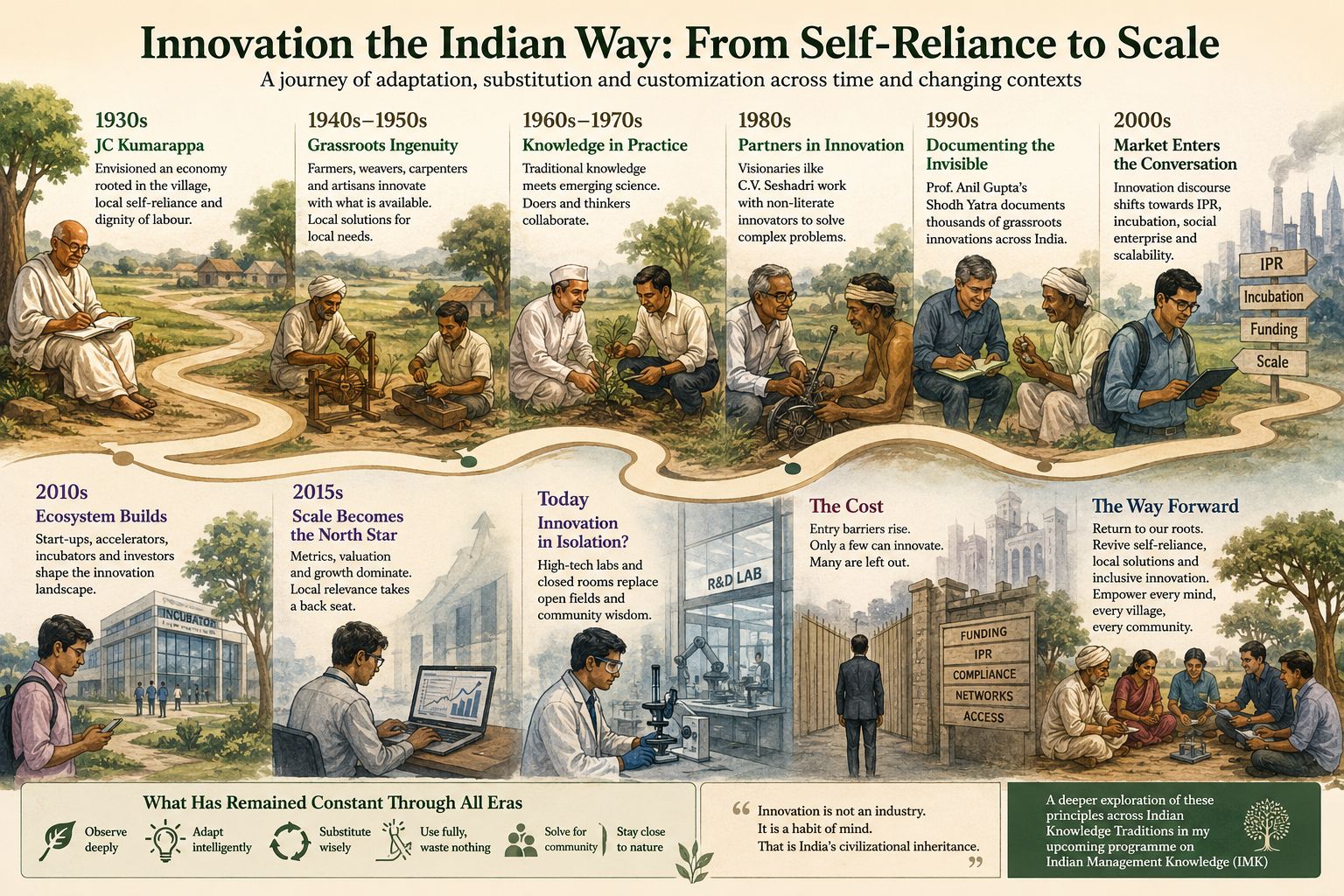
Historically, innovation in India belonged to ordinary people. Something that JC Kumarappa and Gandhi tried to foster through the All India Village Industries Association (AIVIA), a residue of many of these efforts of simple innovations are still available in the beautiful exhibition at the Magan Sangrahalaya.
Artisans, farmers, pastoralists, mechanics, healers, and craftspeople innovated because adaptation was simply the natural way of thinking.
In the 1980s, scientists like C. V. Seshadri demonstrated this by working with non-literate innovators to solve complex technological problems. Since the 1990s, Prof. Anil Gupta's Shodh Yatra documented thousands of decentralized grassroots innovations, revealing that creativity was not concentrated inside elite institutions but distributed across society.
These initiatives celebrated innovation as a social capability rather than a commercial asset.
Gradually, however, the language changed.
Since early 2000s (Ashoka Foundation and social entrepreneurship) Innovation became inseparable from intellectual property, incubation, start-ups, enterprise ecosystems, investment pipelines, valuation, and scale. A market-oriented framework increasingly became the default lens through which innovation was judged.
The test shifted from "Does this solve a local problem?" to "Can this scale?"
Entry barriers quietly rose.
Innovation that once demanded observation, empathy, and ingenuity increasingly demanded compliance, funding, certification, institutional affiliation, and market validation.
Even when jugaad briefly captured global attention, much of its cultural context was stripped away. What remained was a fascination with frugality and resource optimization. What disappeared was the deeper philosophy of self-reliance, local autonomy, and community resilience that had originally produced it.
The difference is profound.
In the Indian civilizational context, self-reliance is the first principle and innovation is its natural outcome.
In the corporate context, profit maximization is often the first principle, with innovation becoming the instrument.
Those are fundamentally different worldviews.
Today, our policy discourse increasingly privileges scale over suitability. Couple of years ago, I attended a meeting at a premier academic institution where the dean remarked that projects below ₹5 crore were simply not worth pursuing. Another much celebrated academician recently is reported to have stated that he only works in solving "impossible" large problems and not small local ones. Statements like these reveal how institutional imagination itself has become conditioned by market metrics.
The tragedy is not merely that small innovations receive less attention.
It is that society gradually begins to believe that innovation itself belongs only to those with capital, credentials, and access.
India's knowledge traditions remind us otherwise.
Innovation is not an industry.
It is a habit of mind.
It begins with observing carefully, adapting intelligently, substituting wisely, and making the most of what is available.
That is a civilizational inheritance worth recovering.
I explore many more examples of adaptation, substitution, and customization across Indian Knowledge Systems in my upcoming programme on Indian Management Knowledge (IMK), where we examine how these principles can reshape contemporary thinking on management, innovation, sustainability, and organizational design. You can register here
Add new comment