23/05/2026:
Recently while have a dialogue around poverty we were discussing the 2-dimensional nature of measurement and addressing of poverty. This morning’s newspaper story caught my eye as an example of how poverty can be a complex difficult phenomenon to understand in the Indian context. 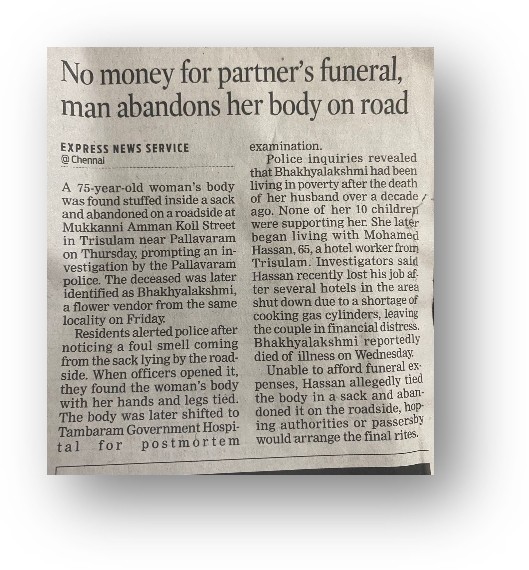
(this is version 2 of this article, the first version was re-written for more contemporary audience placing the story in a larger perspective)
Somewhere in the expanding outskirts of Chennai, where the airport lights blink all night over old villages that no longer remember themselves, a sack lay by the roadside. People walked past it first as people do in cities trained to avert their eyes from the shapes of suffering. Then someone noticed a hand. An old woman’s hand tied inside the mouth of the sack like contraband.
Her name was Bhagyalakshmi. Seventy-five years old. Flower seller. Mother of ten children. Dead.
The newspapers reported it with the efficiency reserved for the poor. A few paragraphs. A chronology of failure. A body found near Tirisulam. A man named Mohammed Hassan. No money for funeral expenses. The body abandoned because death itself had become unaffordable.
And that phrase — *no money for funeral expenses* — travels through India like a quiet epidemic. It appears in police records, hospital corridors, railway stations, flood camps, crematorium queues. It is the final receipt issued by poverty. The point at which even grief must submit to accounting.
Bhagyalakshmi did not become poor on the day she died. Poverty is never an event. It is a long administrative process. A gradual erasure conducted over decades by family, state, market, caste, religion, labour, illness, inflation, and exhaustion. By history itself.
Imagine the arc of her life.
Perhaps she was married at fifteen. Perhaps younger. Somewhere in the 1960s or early 1970s, before India learned to speak the language of GDP growth and demographic dividend. She gave birth to ten children while governments came and went, while slogans changed, while sterilisation campaigns terrified the poor during the Emergency, while cinema heroes became Chief Ministers and promised rice, dignity, revolution.
Maybe she stood in ration shop queues with an infant tied to her hip. Maybe she watched MGR films in makeshift theatres and believed, briefly, in justice. Maybe her children ate noon meals at school from steel plates stamped with the insignia of welfare. Maybe she sold flowers outside temples, threading jasmine into garlands while the city around her turned itself into real estate.
And Chennai did transform. Villages became suburbs. Lakes became bus depots. Air-conditioned towers rose from marshland. The old poor were pushed outward, to the edges of flyovers and infrastructure corridors, where survival itself became subcontracted labour.
Somewhere along the way, her husband died.
And then came the quieter death: abandonment.
Ten children, the newspapers say, refused to care for her.
We do not know their stories. Perhaps they migrated. Perhaps they drive autorickshaws, work in warehouses, live in one-room tenements already overflowing with their own precariousness. Poverty reproduces itself not only through hunger but through emotional exhaustion. The poor are often forced to abandon one another simply to remain alive themselves. Capitalism calls this “individual responsibility.” Society calls it “family failure.” The state calls it nothing at all.
So Bhagyalakshmi moved in with Mohammed Hassan, a man ten years younger, from another religion, another fragile corner of the republic.
There is something profoundly tender and political about this detail. In an India screaming itself hoarse over purity, identity, interfaith suspicion, and televised hatred, two discarded human beings found companionship outside the authorised grammar of belonging. Not ideology. Not nationalism. Just survival. Just one abandoned person sheltering another.
And then even that fragile shelter collapsed. Hassan lost his work. The report says the local hotel economy had slowed because of a shortage of cooking gas linked to war in Iran and global fuel disruptions. See how empire travels. A bomb dropped somewhere in West Asia arrives eventually in the kitchen of a roadside eatery in Chennai, and from there into the stomachs and deaths of the poor.
Bhagyalakshmi fell ill. In a city overflowing with hospitals, clinics, health schemes, pharmacies, insurance advertisements, and promises of universal care, she died without treatment. Not because medicine did not exist. But because access exists in India like citizenship itself: selectively.
And when she died, Hassan could not afford to cremate her.
Think about that for a moment.
A civilisation that spends billions constructing statues tall enough to touch clouds could not guarantee one old woman the dignity of fire. So he tied her body into a sack.
Not out of cruelty, perhaps. Not even abandonment in the usual sense. The act feels instead like the final exhausted calculation of a defeated man. If he left her by the roadside, someone would find her. The police would come. The municipality would do what he could not. The state would enter the story only after death made intervention unavoidable.
This is what poverty does. It criminalises helplessness.
The newspapers call it abandonment of a corpse. But long before Hassan left that sack by the roadside, society had already abandoned Bhagyalakshmi many times over. When she became old. When unpaid labour erased her identity. When healthcare became inaccessible. When housing became impossible. When social security remained trapped inside forms, databases, biometric failures, and indifferent offices. When ten children inherited not stability, but intergenerational precarity. And finally, when death itself became a commodity.
We speak often of poverty in India through numbers. Multidimensional indices. Consumption expenditure. Beneficiary databases. AI-driven targeting systems. Policy dashboards glowing in conference halls. But poverty is not a spreadsheet problem. It is a geography of humiliation. It is the slow violence of being made surplus to the nation’s imagination.
Experts now speak excitedly about artificial intelligence solving development challenges. They speak of predictive governance, smart welfare delivery, algorithmic targeting. But every generation of technocrats arrives claiming to have finally discovered the machine that will rescue the poor. Earlier it was digitisation. Then mobile connectivity. Then fintech. Then platforms. Before that, satellite television. Before that, Green Revolution data systems.
The poor remain exactly where they were: nearest to risk, furthest from power. An AI system may someday predict which family is vulnerable to hunger. But can it measure loneliness? Can it detect the moment a mother becomes socially disposable? Can it calculate the shame of not being able to bury the person you love?
Bhagyalakshmi’s story is not exceptional. That is what makes it unbearable. Across India there are millions living inside this vulnerability spiral — one illness away from eviction, one debt away from bonded labour, one death away from public disgrace. Every failed institution deepens the next failure. Health collapses into unemployment. Unemployment into hunger. Hunger into abandonment. Abandonment into invisibility.
And invisibility, finally, into a sack by the roadside. The tragedy is not only that Bhagyalakshmi died poor. The tragedy is that in the world’s largest democracy, after a lifetime of labour, motherhood, survival, adaptation, and endurance, the system allowed her to become ungrievable.
Comments
It's a very sad story and…
It's a very sad story and only a few could help create awareness and do something in a smaller scale...but the issue requires to be recognised by the government and should do the needful...
A weight case of the…
A weight case of the multidimensional nature of poverty in our country. Your narration of the incidence of poverty of this nature is quite illuminating and insightful.
Our failure to address the poverty issue starts with the way we measure poverty and programmes aimed at addressing them. A substantial number of poverty cases like the one you highlighted could even escape from the the official poverty data.
The only long term solution to eradication of poverty lies in making quality education and health care available to every citizen in the country.
Such an approach will go a long way in striking at the root of not just poverty problem but development as well. The challenge is to come out with a localised solution which in turn call for decentralisation of our governance system, advocated by Gandhiji long ago.
Add new comment