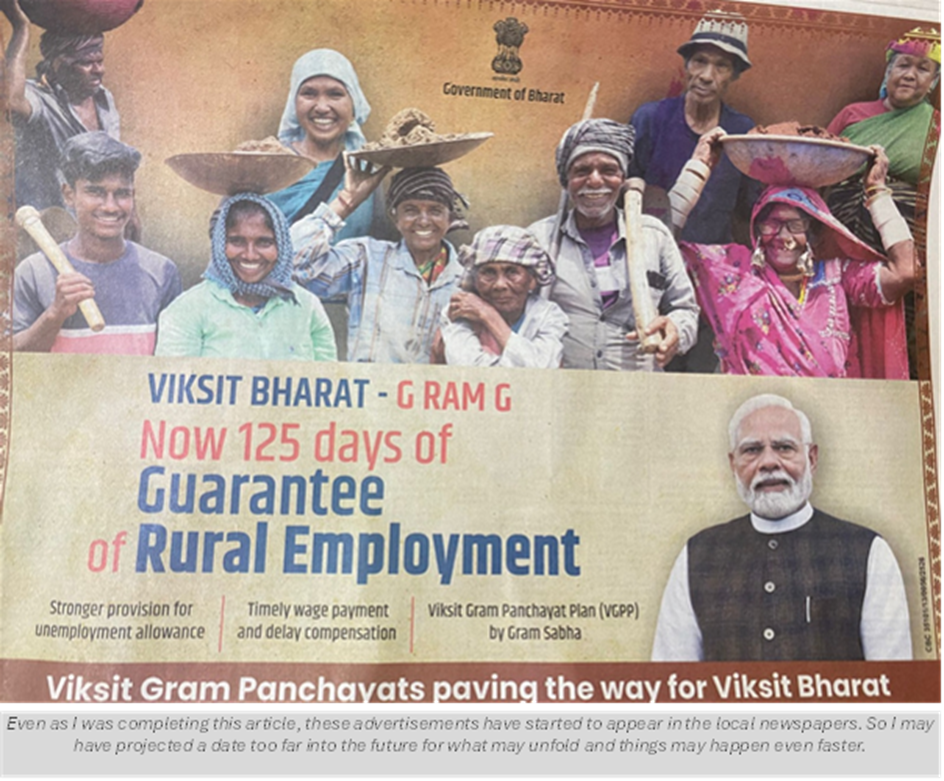
The Government of India in a hurried manner pushed through radical changes in the MGNREGA scheme with a hastily put together debate going late into the night to pass the bill despite much opposition as though our national sovereignty depended on it. Such haste deserves closer scrutiny in a Democracy as much as lack of consultation. I had written a very critical note on the MGNREGA when it was scaled upto the entire nation way in 2007. It has become the world's largest social security programme since and I have seen the programme being utilized at its best for natural resources restoration and sustenance and also the blatant corruption. Like all programmes with good intentions in India, this one too suffers not from the intent but from the vehicle of its implementation. The current Prime Minister had promised to repeal the programme in his first tenure but couldn't do so. This may be his last tenure (unless he makes way for someone younger mid-way during this year), so, the haste could be to ensure that his legacy has this wish too fulfilled. However, the devil is in the details as they say, the haste is not backed by research, detailing or understanding. The babus in-charge, seem to have decided to hitch this wagon too to the avowed stars of the current government with bombastic titles and little detailing beyond privatization and technological induction. My detailed analysis below. - Ram, 15/01/2026
Deciphering the Noise
Rama Rajya is the last refuge of clueless Ministers in the current cabinet[1]. “…This will usher in Rama Rajya” was one of the benefits highlighted by Mr. Shivraj Chauhan in the Parliament as he tabled the replacement the radically revised world’s largest social security scheme[2] – MGNREGA with a hurriedly put together scheme whose sole claim to popularity is the vanguard of the current ruling elite, street smart naming gimmick with not much process understanding and shifting the onus of success of every programme back to people while securing some form of profit potential to private sector from public funds.
As any new policy or changes with the current government, this one too seems hastily done with no consultation, top down, and with very little thought on the process of rolling out. The empty language about new benefits without any evidence, belligerent sounding rhetoric, hype, and hurried pushing through of the Bill itself is a testimony of the unpreparedness of the people responsible for defending and implementing it. The 40 odd page Bill with a vague language is a second giveaway.
How the G Ram G unfolds and undermines the social security net
The key changes that are brought into the MGNREGA as we knew it[3], are –
- Increase in the number of days of Employment Guarantee
- Getting states to contribute to the funding of the scheme
- Normative allocation – a vague term that leaves the amount allocated to the Centre’s discretion
- Compulsory pause during the agricultural season
- Alignment of the works to the Viksit national vision and programmes
Why align with the Viksit Bharat Vision?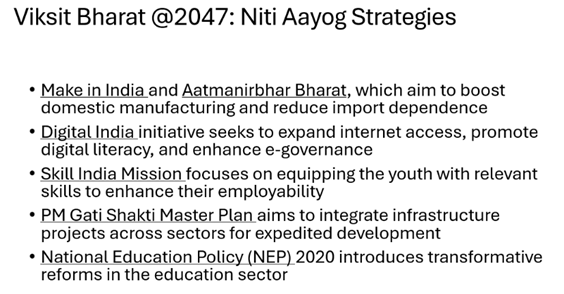
The ‘Vision’ of a social security scheme has been aligned with the ambitious grand proclamation of viksit bharat which already has not met with any of the growth projections it set out for itself. But let me get to that in a moment.
Before that just to get the basics clear. Viksit Bharat and PM Gati Shakti are the two schemes that are named in the G RAM G announcement. In this PM Gati Shakti (wonder why no one thought of abbreviating this as PM GS?!) is already listed as a ‘strategy’ for achieving Viksit Bharat by the Niti Aayog. So, is the scheme PM GS is being doubly billed under G RAM G? that will need a deeper scrutiny for its efficacy and how it can strengthen a social security scheme such as MGNREGA that it tries to replace or for that matter address the structural limitations that the Minister says are being overcome through this new scheme.
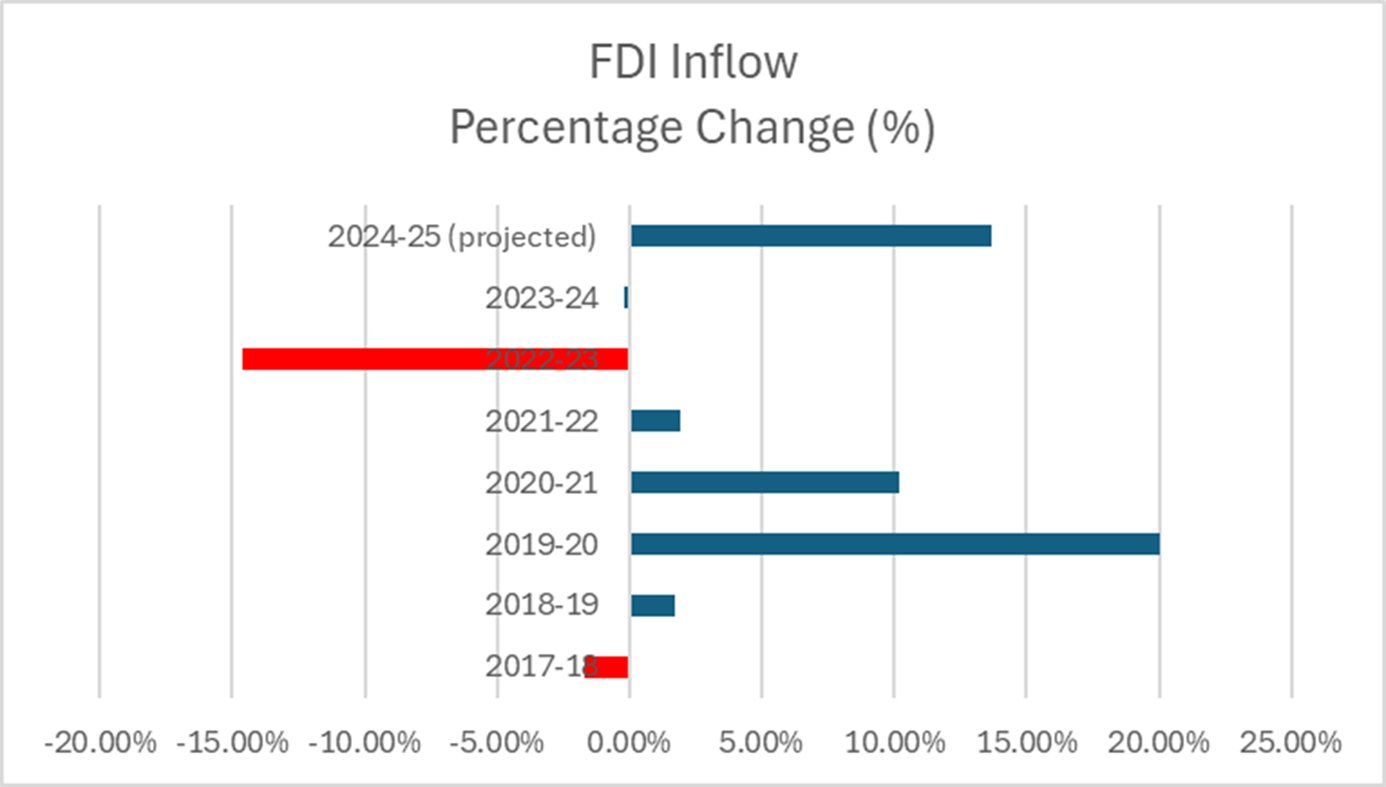
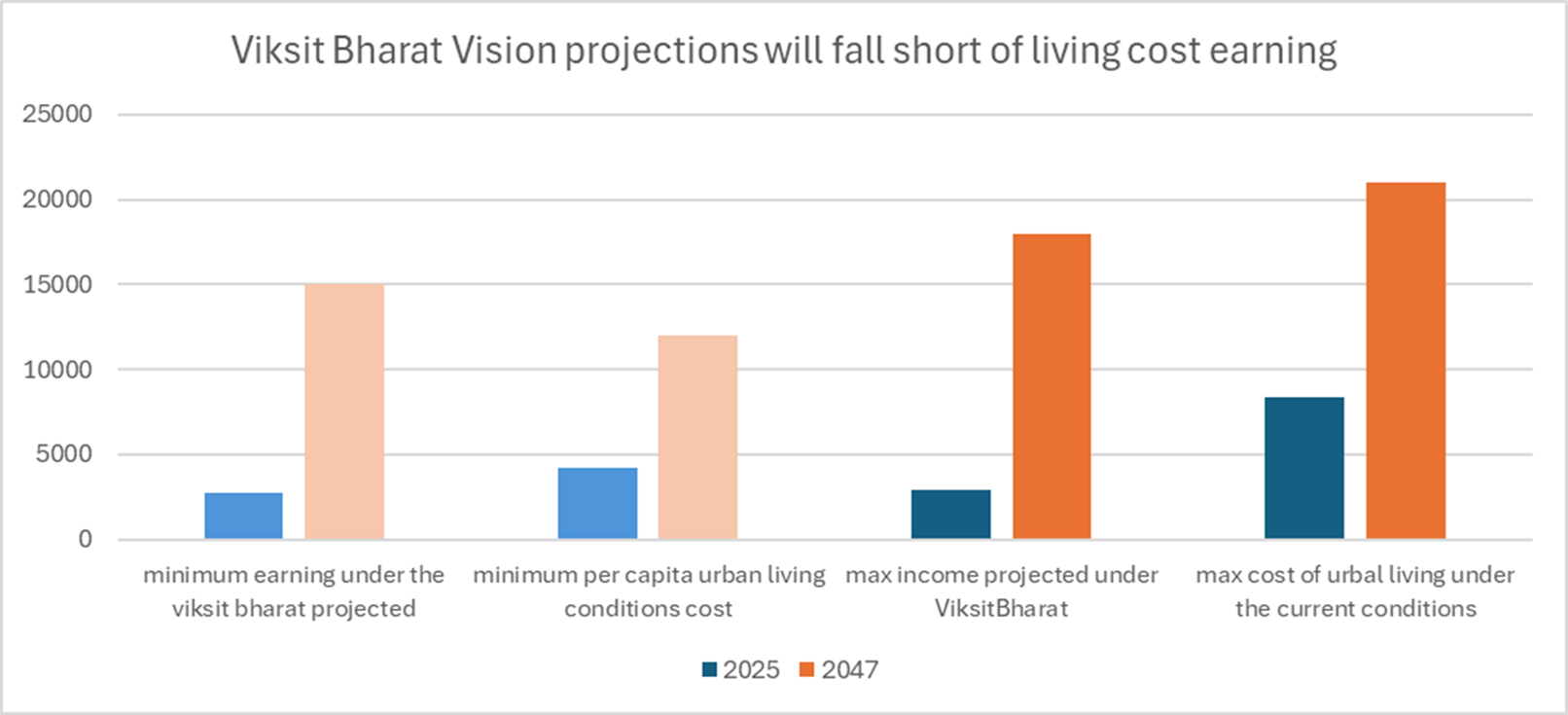
Viksit Bharat's own vision has been impractical by every local and global projection and will require rather radical changes to grow at the rate in which it can achieve its goal. But more importantly, even if it achieves the goal, the projected urban Indian living condition cannot ensure that the per capita income in a Viksit Bharat will be able to afford to live in Urban India.
Make in India and Atmanirbhar Bharat are to do with skilled production and productivity linked growth projections. How can that be equated to a semi-skilled or un-skilled social security job scheme that tries to address the poorest families in their most vulnerable space?
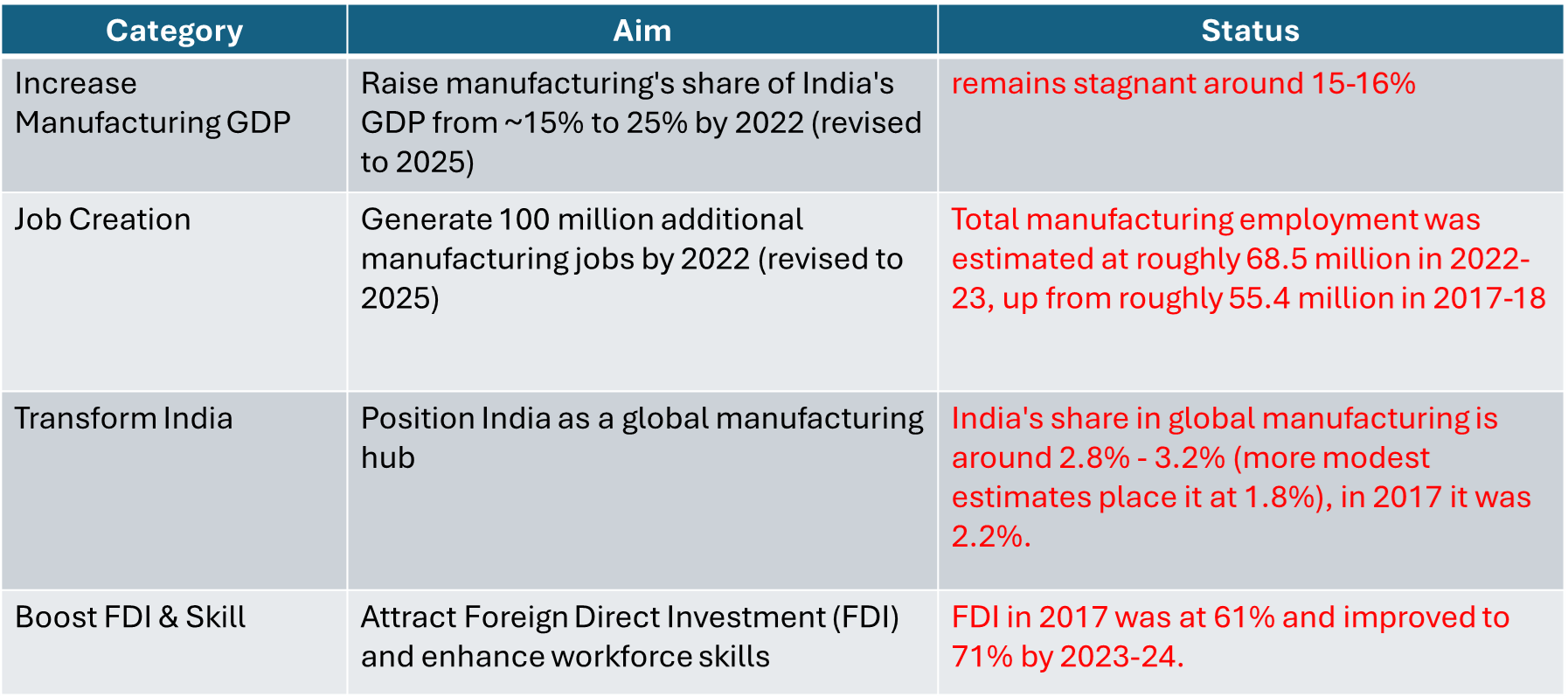
The Make in India vision remains just that, it has not been able to complete even one of its goals till date. If one were to compile a scorecard, there are not many indicators in which the vision seems to be performing very well.
Skill is not seen as an enabling differentiator rather a desirable add-on in most government schemes. So, we cannot fault if the government babus didn’t see this fundamental difference and its implementation conflicts in defining such a scheme with great urgency.
What is the PM Gati Shakthi?
Simply put, it is high speed information processing software that claims to provide precise decision support and is now being forced on the villages to adopt. While India has adopted digital technologies for commercial transactions where the results are tangible, these tools are expensive ones where the results may not be always reliable or tangibly beneficial to the village communities.
How do you justify the increase in the number of days of employment
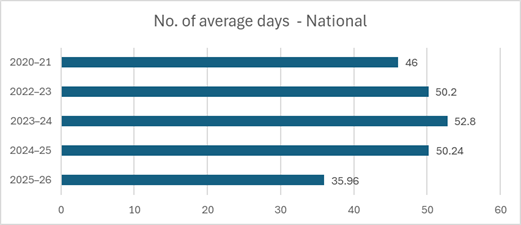
Out of these the 100 to 125 days was already in the anvil[4] despite never really providing 100 days to a significant part of the deserving poor population[5]. Until now if the national average on the total days of employment for a deserving family is less than half of what is intended, on what basis is the increase in number of days justified?
If one were to deep dive into the number of average days of employment generated in different states, the regional variations indicate that the more agrarian regions (eastern, and central states) already do not generate 100 days for those registered active workers under the scheme as much as the more industrial regions of southern states. 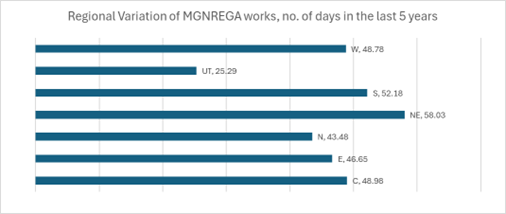
I find it ridiculous that the government that insists on collecting every possible data about everyone does not bother to either substantiate its decisions with any data or its analysis for such radical changes, at least during the announced. As a good governance on public expense, the analysis based on the data collection of public good programmes, ought to be part of all scheme announcements. If anything, it will provide a proof of the return of investment of such massive data collection.
Agricultural Season Pause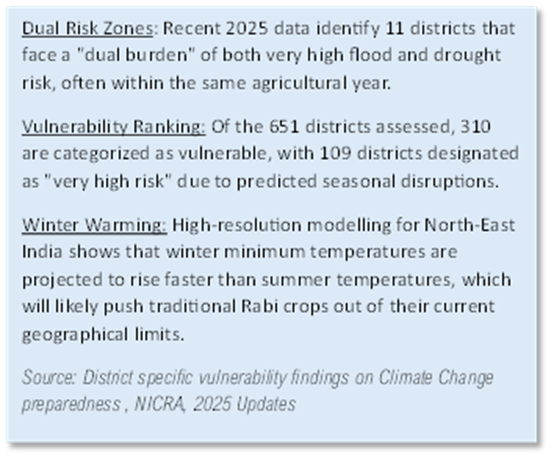
If one looks at the demand on the MGNREGA, one can straight away find that the employment demand comes down during the peak agricultural season across the country. As many have pointed out, the wage of the scheme provides a negotiation benchmark for many agricultural labourers who otherwise would never know how to value their time against the work and remained at the mercy of the large landlords.
I foresee several issues in how such a 60 day pause will be implemented that comes from watching in close quarters how even well-intentioned schemes gets translated into ridiculously implemented government programmes[6]..
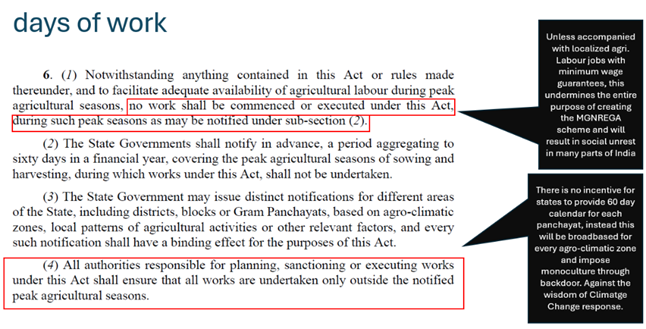
- The 60-day pause will be treated as a one-time assignment as there is no incentive involved in making this schedule for any government official. It may end up being defined in casual manner with no consideration to the climate change scenario that has complicated local agricultural factors significantly in the last decade. A rigid agriculture seasonality definition will be detrimental to the agricultural labour as much as to the social security of the rural workers. Indeed, our own NICRA report says that there is a need for the district level response to be episodic and local. Shivraj Chauhan opposes MGNREGA as episodic in his riposte to Sonia Gandhi[7].
- The pause – particularly in a year of draught or heavy rainfall – if it results in lower agricultural activity, may render higher levels of unemployment locally in some parts of the country. It is no brainer to say that such a situation can be addressed through the disaster response scope provided in GRAMG, because the decision to make such a decision is no longer with the Gram Panchayat but with the Central and State governments.
The key changes
The other three changes being ushered in by the GRAMG are the significant ones from the point of federalism and governance –
(a) Getting states to fund significant part of the programme is basically adding burden to the poorer states as richer states do not have a need for the scheme itself,
(b) the normative allocation with a vague definition is consistent with the BJP method of normalizing additional discretionary powers at the centre, they have done so with every scheme and programme and this legitimizes the same, and
(c) the most devious one is the last point which asks the Panchayat level planning to be aligned with the national vision, rather than the other way around.
Centralized definition of scope of work
Perhaps the biggest shift in terms of the G-RAM-G from the MGNREGS is the centralization of the ‘works’ that can be undertaken by the project.
The 4 areas named are –
(a) water security through water-related works
(b) core rural infrastructure
(c) livelihood-related infrastructure and
(d) works for the mitigation of extreme weather events
– out of which most are already covered already by the MGNREGA, that casts doubt as to why it needs to be replaced if the same work is to be eventually executed? The significant different is the inclusion of “core rural infrastructure’’, something that needs to be defined better as to me this is alarm bell for government expenditure being pushed to expand the logistics private sector in the rural areas. As we all know that the private sector needs to build massive infrastructure in rural areas if they have to engulf all rural economy, they have convinced the government already that logistics industry growth (despite its obvious conflict with energy consumption) is good for the country, reducing every third job created to that of someone mindlessly rushing from place to place to deliver people or goods or both. Now with access to rural markets coming up, local hubs, dark stores, vehicle stations, etc., will have to be built, will the G RAM G be used for the same? I am skeptical if this gives a back door entry to the private sector. True, the private sector potential is given as a possible last chance in the programme implementation priority just now. However, intentions and track record of current government has been on the side of private sector profits rather than public good most times and one needs to be watching out for this.
Surprisingly for such a radical change being brought into such a largescale scheme. The detailing of the permitted list of ‘works’ in the gram panchayat is absent in the new programme. This is against the 73rd amendment of the Constitution that de-centralizes governance with powers to determine and pursue local priorities as decided by the Grama Sabha. The reference to Gati Shakthi alignment deepens my apprehension that the entire effort may be going towards investments in data gathering, disseminating and monitoring gadgets. It will be interesting to watch the changes in the administrative expense of the scheme moving forward. Currently it is one among the nearly 30 indicators that are collected and stands at a national average of less than 3%. I won’t be surprised if this indicator disappears from the dashboard in the near future.
History of MGNREGA
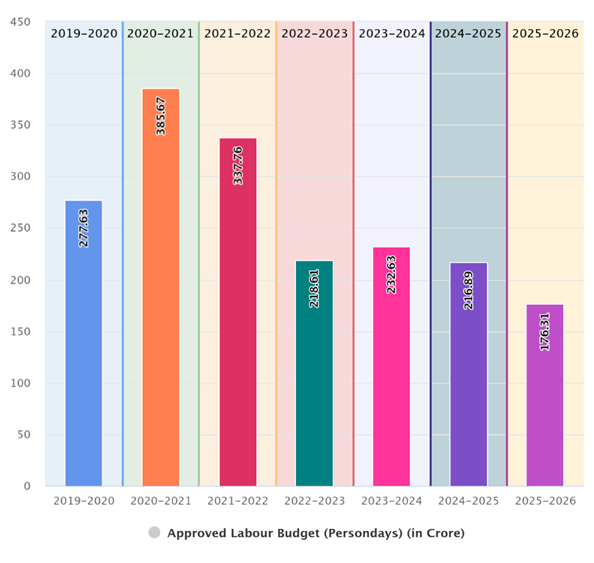
A quick bit of history – The MGNREGA was introduced as a social security net, to provide (from the preamble of the original act) “minimal guarantee of job for semi-skilled and unskilled labour during the times of drought or famine” and implemented in the 100 most drought prone districts of India in 2005. It was in 2007 that this scheme was “extended” to all of India[8]. The simplistic question that I had then was, “if the scheme is only for distress situation how can you extend it to all over the country?” obviously the Government of India does not want to push the entire country to distress situation? I even wrote a paper, probably my first ever on public policy (though I had written a longer series on the GM foods issue in 2000 it was more on publicity by the GM lobby and not as much on a specific policy).
The Left saw the rationalization of the rural labour (even if it came at the cost of the rural societal peace) as a victory in ensuring minimum wage, the Dalit movement activists saw this as an economic freedom way forward for the community caught in the dependent clutches of the rural landlords, the FMCG marketeers saw the direct disbursement of money for rural poor as an opportunity to sell cheap products to them. Some Panchayats, Collectors and even State governments used the scheme wisely to create / strengthen productive assets. While intentionally the scheme could have filled the gap of social security, the real challenge of the scheme is structural rather than functional.
Rajendran Narayanan and Annie Raja[9], state the following as the key benefits of the scheme –
“In spite of the programme functioning at half its mandated capacity (the average number of days worked per household has been around forty-seven days for the last five years) and despite numerous implementation challenges, it has had a far-reaching impact. Five board positive aspects can be identified:
(a) it is universal and not targeted
(b) increase in rural incomes
(c) countering of gender and caste inequalities
(d) quality asset creation and
(e) community empowerment.”
But pilferage was high and continues to be. Majority of the political parties saw this as an easy cash cow to be milked to give free money to their own respective cadres. The number of tasks locally started vs. those completed remained low across the country for a long period of time. Direct money transfer into the beneficiary bank account was not implemented as it would mean direct cut transfer will have to change. However, it got implemented soon enough with local functionaries having worked out ways of securing their cut. As writer Manu Joseph says “..the fact is that the corrupt politician is useful to the poor…and…will do anything to win elections, including actually doing good[10]”.
In states like Tamil Nadu where none of the major political parties have any respect for Panchayats and prolong the gap between Panchayat elections and maintain village level control through Special Officers and Accountants at the Panchayat office, this scheme has created institutional corruption at the village level. Then came the age of make-believe dashboard and everyone became a digital fake image creation expert overnight. While the MGNREGA website gives data updated on a daily basis for the government of India to justify the continued investment, there is no guarantee that any of the works happen on the ground.
Modi and MGNREGA
“MGNREGA is a living monument of your failures. After sixty year of Independence, you must send people to dig holes. This is a monument of your failures, and I am going to carry on beating the drum about it with much fanfare. I will tell the world that the pits you are digging, they are the result of your sins for sixty years”, Prime Minister Modi in 2015 after winning the first term.
The scheme has remained politically popular and untouched. Modi during his 2014 election campaign had said he will discontinue the scheme once he comes to power and for three terms has not been able to do much, except use discretion to deny funds allocation to opposition ruled states like West Bengal.
The centralization and concentration of powers, from individual lifestyle choices to that of Panchayats, District Courts, to State Governments, has long been the aim of the ideological institution like the RSS. Gandhi’s idea of Rama Rajya is different. So, to replace Gandhi’s name with that of G Ram G is not just beating Gandhi using his own favourite God’s name, but, also ensuring that every major Indian programme is linked to Lord Ram in some way. I suspect it is the beginning of an attempt to eventually replace Constitution of India with some other scripture.
The loud and focus-less Opposition response
The Opposition response is interesting, most of them seem to object to the removal of the name of Gandhi from the scheme. In fact, Sonia Gandhi claimed that MGNREGA dilution was against Gandhi’s vision of Gram Swaraj. This was a bit high coming from the INC as the Congress has driven the country away from the vision of Gram Swaraj through the path of ‘development’ they chose to pursue long enough. Such a social security scheme is in fact necessitated due to lack of addressing the social inequality in continuous pursuit of a mis-placed economic ideas of Development pursued by INC and accelerated by the BJP. Gandhi called mis-placed economic ideas as dirt[11] and not Swaraj. Swaraj for him started with ensuring dignified jobs for everyone where they lived and not in faraway industrial clusters. The riposte to Sonia Gandhi from the Minister was even more absurd – he started with an unnecessary discourse on why welfare need not be divorced from ‘development’. I wonder what Gandhi himself would have said to both the Minister’s idea of Ram Rajya and the opposition’s objection to it in his name[12].
So, whereas Gandhi felt dignity and inclusive growth for everyone should be our ‘development’’ and INC imposed an idea that reduced welfare of the weak as a necessary corollary of its pursuit of development, BJP today wants us to believe its idea of development IS welfare for the masses regardless of their capacity. The centrality of defining what is good for everyone, including the remotest village in the country by a few men, is an ideological assault on the diversity and de-centralized governance vision of India. Lord Ram was a King and the vision is to usher in a Kingdom, and if it doesn't align with Democracy, tough luck.
Disclaimer: Most of the data in this article have been generated using AI tools, sourced from government data available online at the time of sourcing them. However AI tools do make mistakes and Govt. itself is known to be fictitious some times with its numbers and even worse now it uses too much AI as well, kindly cross verify the numbers before citing them. Thank you.
[1] Patriotism is the last refuge of scoundrels, is a quote attributed to Samuel Jhonson, 1775. Bernard Shaw is supposed to have tweaked it a bit replacing patriotism with ‘politics’
[2] With 84 million active job cards and over 110 million active workers, MGNREGS is probably the world’s largest single employment scheme anywhere (source)
[5] As per the Government of India data, in the financial year 2023-24, approximately 7.5% of households that availed work completed 100 days of employment. In the most recent data available for the current financial year (2024-25), this figure was around 7%, with the average days of employment per household being approximately 50 days.
[6] In the charting of the guidelines for implementation, in the role assignments, in the detailing of the programme, in the capacity building for the down the line staff for the programme, oversight, grievance redressal, and in the review process of the programme, these are where the devil of mediocrity and undermining enter
[7] Published in the HINDU OpEd
[8] Extending a scheme was primarily seen as based on a political decision at that time by the Congress government as it helped them to win election in some large state
[9] Rajendran Narayanan and Annie Raja in their article MGNREGA: A Distress Saviour or a Saviour in Distress? As part of the We The People series publication
[10] Manu Joseph, Why the Poor Don’t Kill Us
[11] Mis-placed matter is dirt, so is an economic theory… - Gandhi
[12] I have written about it earlier and for those more interested, have a compilation on Gandhi’s quote on Ram rajya here is the link to the same - https://youtube.com/shorts/XT7bg21RL_A?si=H0Pjpdy1d0fjoeJW