Hind Swaraj is arguably the greatest text to have emerged from the anti-colonial movement in India and perhaps the first to seriously challenge the cultural and civilizational premises of the colonizers’ mentality. It is also the first text in India that falls recognizably within the broad tradition of modern political philosophy, advancing a complex cluster of theses with conceptual sensitivity, analytical precision, and sustained argument. It is sharp, crisp, and elegant, dialogic, even conversational in style but relentlessly hard hitting, scathing in its critique and yet full of humanity. It is a little, perfectly cut gem laden with productive tension between the self, as much an attack on enslavement as on voluntary servitude. – Rajeev Bhargava, former Director, CSDS, 2009
Hind Swaraj reading and interpreting for the current times remains one of the most impactful programmes of Samanvaya. Each year, we have a completely new set of students, ranging from entrepreneurs, professionals, writers, farmers, teachers, artists, to students joining us in this perspective building programme.
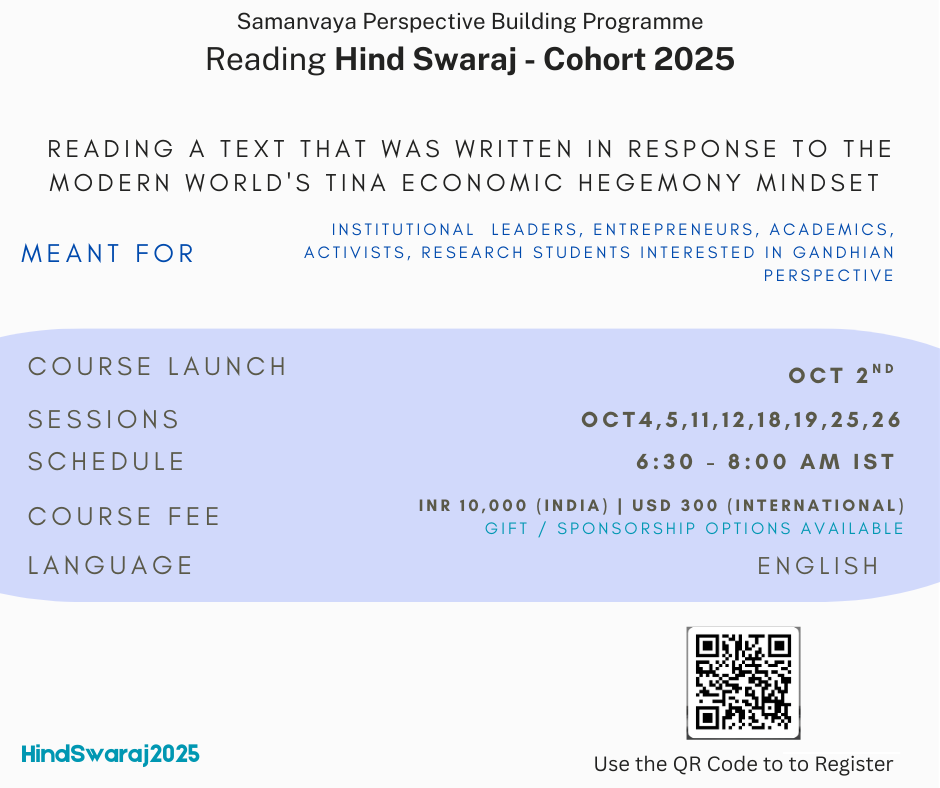
Programme Launch: 2nd Oct 2025 | 6:30 - 8:00 hrs (IST)
Programme Schedule: All weekends of Oct 2025 (4,5,11,12,18,19,25,26) | 6:30 - 8:00 am (IST) - 8 sessions in all of 90 mins each.
Programme: Online Live (no recording available in case you miss a session)
Language: English
Course Format: Presentation on selected portions of Hind Swaraj (Sat session) followed by discussion (Sun session).
Prior Reading / Course Reading: Prior reading not compulsory, course time reading material provided as additional material if participants are interested
Course Fee: Recommended INR 10,000 per candidate for Indian candidates, for international candidates, $300 (sponsorships and gifting options available). While with the current tariff war happening, we were tempted to add 60% extra for US candidates, we recognize that it is not the people of the USA that are to be blamed for this. So, we have revised the price to more affordable rate for US and other countries as well.
Programme Facilitator: Ram, Director, Samanvaya
Registration for the cohort 2025
Additional Practitioner Sessions (open for prior Hind Swaraj cohort candidates as well):
- Nov 8th 2025 | 6:30 - 8:00 am (IST) | Post-AI Knowledge
- Nov 22nd 2025 | 6:30 - 8:00 am (IST) | Post-Growth Development
- Dec 6th 2025 | 6:30 - 8:00 am (IST) | Post-Truth Religion
Post-AI Knowledge: What do we lose in outsourcing the process and speed of "knowing"? What does it mean to “know” something if external intelligence can perform the knowing? How do we validate human competence when AI simulates expert-level performance and at speed that is extra-human? Whose understanding guides policy when algorithmic recommendations shape consensus? Are humans doomed to be in outdated echo-chambers while the algorithm gains undue advantage of markets, policies and science? What are our ethical challenges?
Post-Growth Development: GDP centric, global linear growth of economies no longer can be sustained considering scientific and ecological evidence. Global, regional and local inequalities and the aspirations driven by ever growing extractive economy opportunities to address them, need to provide a regenerative ethos. What are the regional and local priorities? where do policy shift?
Post-Truth Religion: Religious knowledge, like political truth, succumbs today to echo chambers, emotional conviction, and curated digital performances. Resulting in consumerist, choose-your-own-adventure spirituality, detached from institutional accountability or earth ethics, yet fiercely politicized. Post-truth religion mirrors the epistemic conditions of post-truth politics. Communities rally around provably false claims—not despite their falsity, but because belief in untruths becomes a test of tribal loyalty. Cognitive dissonance bonds stronger than shared doctrine ever did. What is the future of religion in this era?
Below is a personal note written by Ram, Director of Samanvaya who remains the main facilitator for the annual programme.
 I
I Ram's note on reading Hind Swaraj -
I first read Hind Swaraj sitting at the Bapu Kuti in Sevagram Ashram near Wardha in summer of 2000, where Gandhiji spent a considerable part of his life after he returned from South Africa. This phase of his life is significant as there were several experiments in organising village industries, education, institutional building among others. The residue of some of these institutions, both as memory shared by the people and institutions that functioned, where still there when I read the book.
It was the late Gandhian Historian, Dharampal who made me read the book. It was not a book I had encountered earlier and it opened up Gandhi as a completely different persona to me. I should confess it was a time of intense exposure to diverse knowledge for me, whether it be Gandhi or the archival documents of Dharampal and even more so, conversations with him and other Gandhians who either lived there or visited often. So, the time I spent on Hind Swaraj based discussions were rather limited while at Sevagram itself.
The impact of this book on me kept increasing with my experience with village communities in the next two decades. I could see the increasing relevance of both the criticism of Gandhi on the western form of civilization and its manifestation through a system of government and society and his emphasis on the inclusive and unified Indian society creation as the way forward. Every space in which the civilizational India in its diverse ways finds itself confounded in dealing with the modern economy and society, has its roots in the diversion from the contours of social evolution that Gandhi outlines in this little booklet.
Among scholars, there is no other thorough critic of the western civilization till date by any other thinker from an ethical point of view. My subsequent interactions with several thinkers and activists, particularly Ven. Samdhong Rinpoche, Dr. Claude Alvares, Sri. Pawan Gupta, Md. Idris, Sri. Rajiv Vohra, the PPST group and many others have reinforced my own observations on the lack of adequate materials. Several books over the years have been written specifically on Hind Swaraj by scholars.
Since 2000, I have tried to read this book every year at least once on the 2nd of October, Gandhi's birthday. Samanvaya had organised Hind Swaraj joint reading sessions in 2001 and again in 2004 as a weekend course over 2 months, we also organized a Hind Swaraj camp in 2005 at Gandhigram. In 2007, we had organised a Hind Swaraj centenary lecture by Ven. Samdhong Rinpoche in Chennai as well. We also compiled and released a small booklet, ‘’Let’s Talk Swaraj’’. I have made Hind Swaraj a mandatory reading for some of the bright students that have interned with me apart from prescribing it to several social activists.
Ven.Rinpoche has more than once said that today he places the learning of Hind Swaraj above that of even the Dhammapada for young Tibetan students. One of our mentors, Sri. Mukundan calls this book a grantha (or a cannon) - a literature that has the power to transform by itself. I have seen this during these two decades of working with this book, its capacity to transform people.
These insights and experiences is what I intend to share through the course starting online each year on 2nd Oct and every weekend through October. There will be an in person bootcamp after the course, for the participants if they want in the month of January.
This online course is meant for anyone having deeper questions about India and wanting to explore the same.
----
There is a good general purpose introduction to the importance of this publication in the Gandhi serve that is available. There are several online articles engaging with the diverse areas that Hind Swaraj provides scope to expand. We also have an old blog that has some of our earlier material on Hind Swaraj here